
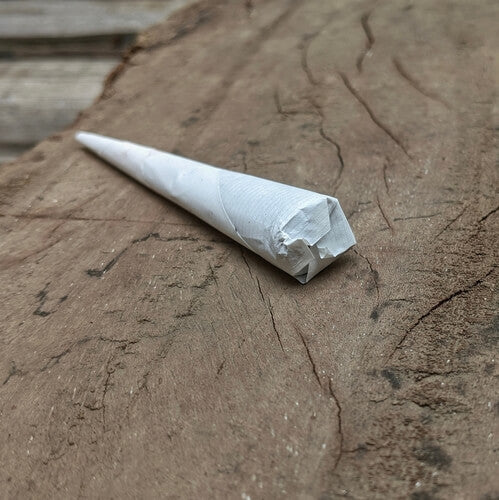
Pulling a pre-rolled cone out of the package feels like an instant win because the factory already handled the delicate folding, glued the seam, and set the crutch in place. Most folks figure you can dump whatever dry plant material you want down that paper funnel, tamp it down with a packing rod, and get the exact same smooth pull every single time. Light up a batch of springy, moisture-cured tobacco ribbons, though, and you'll quickly realize that fast-burning leaf reacts nothing like the dense, sticky smolder of ground hemp flower. That tapering hull forces air, heat, and expanding botanical matter into a funneling bottleneck that transforms how each material burns from the broad rim down to the mouth tip. Figuring out which plant truly belongs inside that pre-shaped paper shell comes down to how each one handles combustion heat, resists packing pressure, and smokes through the final stretch.
The Mechanics of the Cone: Why Shape Changes the Entire Session
A pre-rolled cone isn't just an empty paper tube; it's an engineered funnel with a fixed taper, a factory-glued longitudinal seam, and a pre-inserted folded crutch at the base. You aren't shaping a cylinder between your fingers or licking an adhesive strip. You're working with a rigid, hollow container designed specifically to be filled from the wide top opening down to the narrow neck. Because that shell tapers inward, the internal volume drops sharply as you move toward the mouthpiece. That changing volume directly controls how air moves through the pack and dictates how the filler settles against the paper walls when tamped.
At the wide foot of the cone, the burning surface area sits at its absolute widest. Lighting that broad brim spreads the heat across a generous plane, keeping the cherry's early surface temperature moderate and letting outside air dilute the draw. As the ember works its way down the body, that surface area shrinks. Because your lungs pull with steady force, that incoming draft gets forced through a progressively smaller channel, causing the air stream to pick up speed. This rising air velocity acts like a bellows on the burning coal, kicking up internal heat right as the smoke draws closer to your lips.
Tamping material into a pre-made paper shell creates structural demands that flat papers never face. Since you're dropping loose material down an open funnel and pressing downward with a slender packing rod, the factory gum line has to resist outward bursting pressure. At the same time, the paper walls must possess enough structural stiffness so they don't crinkle, buckle, or accordion during the pack. Pre-rolled cone makers construct these shells out of a few distinct plant fibers that react uniquely to compaction and heat:
-
Natural Unbleached Wood Pulp Cones: These feature thicker, stiffer paper walls that handle aggressive tamping without wrinkling, while microscopic pores across the body vent excess heat away from the narrowing funnel.
-
Ultra-Thin Rice Paper Cones: Built for absolute transparency and minimal residual ash, these fragile pre-shaped hulls have almost no physical stretch, meaning an uneven shove from a packing poker can easily split the factory seam.
-
Natural Hemp Fiber Cones: Offering a sturdy middle ground, these pre-formed shells provide pliable walls that flex under packing pressure, pairing durable tensile strength with a steady smolder that tracks well with heat.
Beyond paper tension, that narrowing funnel acts as an active condensation trap. Hot smoke doesn't simply glide through the crutch without leaving a trace; it sheds vaporized oils, plant moisture, and aromatic compounds onto the unburned material waiting down the line. In a straight cylinder, that runoff deposits across an even, open column. Inside a cone, those settling liquids get squeezed into a tight, compacted bottleneck. By the time you reach the final third of the session, the material right above the crutch has completely changed, turning into a saturated filter that holds all the heat and residue gathered from the wide brim above.
Exploring Rolling Cones for Tobacco and Hemp Flower Use
Dropping shredded cured tobacco or fragrant botanical buds down an empty paper funnel might seem like two paths to the exact same destination. The physical realities of these two cured crops, though, couldn't be further apart once you pack them into a tapered paper sleeve and introduce an open flame. Tobacco relies on broad, dry-cured leaves with springy veins that demand careful tension, so you don't burn through the paper wrapper in three quick minutes. Botanical flower packs a sticky web of dense floral calyxes and volatile oils that require a completely separate approach to heat transfer, airflow, and density.
Rolling Cones for Tobacco: Leaf Behavior, Heat, and Airflow
Packing cured tobacco shreds into a pre-formed cone flips conventional smoking traditions upside down. Traditional cigars depend on thick, moist binder and wrapper leaves to regulate airflow, while pipe smokers rely on the dense briar walls of a bowl to absorb heat and excess juice. When you transfer loose tobacco into a paper cone, you're placing a fast-burning leaf inside an ultra-light paper wrapper that offers zero moisture absorption. The conical chamber exaggerates every habit of the leaf, meaning any mistake in moisture assessment or tamping pressure will show up immediately in the draw.
Leaf Cut, Moisture Profiles, and Expansion
The way tobacco gets sliced dictates exactly how it seats inside a narrowing paper funnel. You'll run into three primary cuts across loose-leaf blends, each creating its own structural tension against the paper walls:
-
Fine Shag Cut: Shredded into hair-thin strands, shag packs down fast and lights instantly, but it packs so flat that it can choke off airflow near the crutch if you tamp it with any real weight.
-
Ribbon Cut: Sliced into medium, ribbon-like ribbons, this cut provides an interlocking scaffold that breathes naturally, though the stiff leaf midribs will poke through thin paper walls if you force them.
-
Flake and Broken Flake: Thick, pressed tobacco slices that require extensive rubbing out by hand before filling, otherwise large, dense chunks create air tunnels that let fire race down the seam.
Moisture equilibrium makes or breaks this interaction. Cured pipe and rolling tobaccos are at their best when conditioned between 12%-15% moisture content. If your tobacco has dried out below that threshold, the brittle shreds crumble into fine dust the moment your packing rod makes contact. That powder drops straight to the bottom of the funnel, forming an impenetrable barrier right against the folded crutch that suffocates your draw.
Conversely, if the tobacco sits above 16% moisture, you're walking straight into an expansion trap. When hot combustion gases pull through moist cured leaf, the water trapped inside the cellular structure heats up, turns into steam, and causes the leaf tissue to swell. In a rigid pipe bowl, that expansion doesn't matter much. Inside a delicate paper cone, that swelling leaf pushes outward against the glued seam while expanding inward, locking the airflow solid after the first half-inch of ash.
Combustion Temperatures, Ash Stability, and Heat Spikes
Tobacco leaves pack a heavy concentration of natural mineral salts, nitrates, and potassium, which gives the leaf an exceptionally high baseline combustion temperature. A working tobacco cherry burns between 600°C and 800°C during an active puff. That high heat creates an ember that stays lit without constant attention, but inside a cone, that roaring heat source can easily outpace the combustion rate of the paper wrapper.
When air rushes into the wide foot of the cone, that rush of oxygen supercharges the tobacco cherry. If the leaf isn't packed with uniform density, the ember follows the path of least resistance, boring a narrow tunnel of fire straight down the center of the roll while leaving the outer perimeter untouched.
Ash formation plays a huge defensive role here. High-grade tobacco leaf produces a thick, interlocking gray ash that clings together in a tight cylindrical plug. That ash plug acts like an insulating thermal cap, shielding the live cherry from raw drafts and stabilizing the combustion pace. In a tapered cone, though, the shrinking diameter offers less physical support to hold that ash column in place. As the ash snaps off, cool outside air slams straight into the bare cherry, creating sudden temperature spikes that can singe the factory glue line and cause the paper to run wild down one side.
Flavor Concentration Down the Funnel
Every puff pulled through a tobacco cone draws vaporized water, nicotine, natural oils, and heavy condensates down through the unburned leaf waiting below. In a classic stogie, those heavy byproducts have inches of thick leaf layers to filter through and absorb into. In a pre-rolled paper cone, the thin paper wrapper can't absorb liquid runoff, forcing those heavy condensates to collect directly on the tobacco strands sitting right above the crutch.
As you smoke through the first half of the cone, that wide burning foot produces smooth, airy smoke because the large volume of leaf dilutes the draw. As the ember travels past the midpoint, the conical shape forces all that trapped heat and collected moisture into a tight bottleneck. The tobacco resting near the filter becomes dark, damp, and heavily saturated with bitter condensates.
At the same exact time, the narrowing diameter forces your draw velocity to spike, pulling hotter air across that saturated leaf bed. If you puff on a tobacco cone with the rapid cadence used for a straight cigarette, that concentrated heat turns the smoke harsh, acrid, and unpleasantly bitter in the final two inches. Enjoying the bottom third demands that you deliberately back off your draw pressure, taking gentle, measured sips to let the coal cool down between puffs so the concentrated leaf doesn't scorch your palate.
Rolling Cones for Hemp Flower: Resins, Terpenes, and Oil Rings
Switching over to cured hemp flower introduces a completely new set of physical rules inside a paper cone. You aren't dealing with broad, uniform leaves here. Cured botanical buds consist of dense floral calyxes coated in thousands of tiny glandular trichomes packed with cannabinoids and aromatic terpenes. Light up that mix, and you aren't just burning dry plant matter; you're dealing with a botanical structure that transforms into a hot, bubbling liquid right behind the active coal. Handling that shift inside a tapered paper funnel requires balancing oil migration, particle size, and thermal transfer from the very first spark.
The Resin Factor and the Infamous "Canoeing" Problem
As heat pulls through the wide foot of the cone, the temperature just behind the glowing cherry spikes well past the boiling point of botanical oils. Those resinous trichome heads melt into a viscous, golden fluid that wicks backward into the unburned calyxes and seeps into the paper walls. You'll often see this show up as an active resin ring, a dark, oily halo that forms right below the burning paper line. In a balanced pack, this hot ring works in your favor by slowing down combustion and producing thick, rich vapor.
When density inside the paper isn't uniform, that same resin becomes the primary culprit behind canoeing. If one side of the funnel is packed tighter than the other, incoming air naturally diverts toward the looser side. The loose side burns hotter and faster, vaporizing its resin cleanly and racing down the seam. Meanwhile, the cooler, tighter side drops below active combustion temperature, allowing the liquefying oil to soak into the unburned flower and paper without catching fire. Saturated paper demands far higher heat to burn than dry paper. Once that happens, the dry side races ahead, leaving a massive, unburned trough of oil-soaked flower trailing behind like a lopsided canoe. Rotating the cone between puffs and applying quick lighter touch-ups to the lagging edge can save the burn, but preventing that resin trap starts with an even, centered pack.
Finding the Sweet Spot Between Powder and Chunks by Using ‘Grind Dynamics’
The consistency of your milled flower controls whether a cone breathes effortlessly or clogs like wet cement. Cured hemp buds aren't uniform; they're composed of spongy calyxes, sugar leaves, and stiff little stems. Dropping whole or hand-torn chunks directly down the paper funnel is an easy recipe for air chimneys. Fire loves empty gaps, and large chunks leave hollow channels where hot air rushes past without lighting the flower, burning straight holes into the paper body.
Milling too fine brings the exact opposite headache. If you crank a four-piece tooth grinder until the flower turns into chalky dust, you'll create a catastrophic bottleneck. As you tamp that powder down into the cone's narrowing throat, the particles lock together with zero air space between them. Even worse, fine botanical dust easily slips past the folds of the pre-inserted crutch, pulling bitter plant bits straight into your mouth on your initial draw.
The sweet spot is a medium-coarse, fluffy consistency that resembles coarse sea salt. You want clean, distinct calyx flakes that retain their spongy elasticity. When pressed gently with a packing rod, these spongy fragments interlock without collapsing into a solid plug. This texture creates thousands of microscopic air pathways that let heat disperse evenly through the cone, maintaining steady draw resistance while stopping loose plant dust from migrating through the mouth tip.
Terpene Preservation and Low-Temperature Draws
Hemp flower shines brightest when delicate aromatic compounds called terpenes stay intact. Fragile terpenes like myrcene, pinene, and limonene possess relatively low boiling thresholds, starting to vaporize at temperatures as low as 310°F to 350°F. That's well below the actual combustion point of plant cellulose, which means the best flavor in a cone doesn't come from burning the flower; it comes from the wave of convective heat that washes ahead of the cherry.
The wide bell of the cone is an absolute gift for terpene delivery. Because the top diameter is wide, incoming air moves across a broad front of unburned calyxes at a lower speed. That gentle draft warms the flower without scorching it, releasing bright, sweet aromatics straight through the mouth tip on the first half-dozen pulls.
The challenge arrives as the ember works down into the narrow half of the cone. As the internal volume tightens, that same volume of air is forced through a shrinking cross-section, kicking up air speed and funneling accumulated heat directly into the remaining flower. By the time you reach the final third of the roll, that flower has endured minutes of hot convective exhaust, baking off the delicate top-note flavors and leaving behind heavier, harsher compounds and tar. To protect the flavor profile down the home stretch, you can't rip on the cone like a shop vacuum. Taking shallow, patient draws curbs thermal spikes, allowing the last calyxes to burn clean instead of scorching under their own heat.
The Combustion Showdown: Head-to-Head Variables
Stacking cured tobacco leaf directly against milled hemp flower inside identical pre-rolled cones exposes just how differently these two plants behave under flame. While both rely on the cone’s tapering geometry to deliver smoke through a built-in crutch, their internal combustion dynamics run on completely separate engines. How each plant burns, breathes, reignites, and fills the room comes down to distinct physical and chemical traits. So, let’s break it down here, shall we:
-
Burn Speed and Thermal Retention: Tobacco leaves contain natural nitrates and mineral salts that fuel a self-sustaining, aggressive ember. Once you fire up a tobacco cone, that cherry burns hot and stays lit on its own, even if you set it resting in an ashtray for several minutes. The risk here is that an active tobacco ember can easily run away from you, consuming paper and leaf faster than you can puff. Hemp flower operates under the exact opposite rule. The high oil and resin content within the floral calyxes acts as a natural flame retardant. Without steady, rhythmic draws pulling fresh oxygen across the coal, a hemp cone's ember temperature quickly drops below the combustion line and snuffs itself out.
-
Draw Resistance and Airflow Velocity: The physical geometry of the filler dictates how hard your lungs have to work on every pull. Tobacco shreds retain a natural, springy recoil that pushes outward against the cone’s paper walls. That spring-back forms a resilient, interconnected mesh of leaf fibers with hundreds of tiny air corridors, allowing air to glide through with very little resistance. Milled hemp calyxes lack that spring-like structure. When tamped into a funnel, ground flower settles into dense, flat layers. As smoke travels down into the narrow neck of the paper, that settling plant matter packs together, creating noticeably higher draw resistance that demands a deliberate, steady draw to keep the smoke flowing.
-
Relight Tolerance and Cold Restarts: Smoking habits often get interrupted, but how these two materials handle a cold restart is night and day. Tobacco cones suffer horribly if you let them go out halfway down. When an ember dies, heavy combustion tars and liquid condensates settle into the cold leaf shreds behind the coal. Firing that cone back up burns through those stale, condensed byproducts, blasting your palate with a bitter, sour ash flavor that ruins the rest of the smoke. Hemp flower proves far more forgiving. Because its unburned residue consists largely of hardened botanical oils rather than stale leaf tars, you can snip off the charred black tip with a pair of shears, spark the clean green edge, and recover a respectable portion of the original herbal flavor.
-
Aroma Output and Environmental Drift: The ambient smoke pouring off the wide foot leaves an unmistakable footprint in any room. Tobacco combustion releases dense, dry, alkaline smoke that carries heavy particulates into the air. That smoke clings stubbornly to curtains, furniture, and clothing, leaving a stale odor that lingers long after the ash cools. Hemp flower produces an aromatic, oil-rich vapor trail driven by volatile terpenes. While the initial herbal aroma is thick and immediately recognizable, the smoke’s less dense in particulate weight, thus allowing the scent to dissipate from open rooms and fabrics far faster than the persistent, heavy fog of burning tobacco.
Packing Technique: Dialing in Density for Each Material
Shoving dry plant matter down an open paper funnel with brute force is the quickest way to ruin an afternoon smoke. Packing a pre-rolled cone isn't about ramming filler into a tight tube until it won't hold another crumb; it's a careful exercise in pressure distribution. Because that paper sleeve tapers down toward a narrow base, applying the exact same tamping force from top to bottom creates an uneven density nightmare. The narrow neck chokes under minimal pressure, while the wide mouth stays loose and flabby. Getting a smooth, even burn means tailoring your packing motion to match how each plant settles against paper.
Tamping Tobacco: The Compress-and-Settle Method
Tobacco leaf features a springy physical structure that fights back against your tamper. If you grab a large wad of ribbon or shag and force it down the mouth in one heavy push, the leaf bundles together, grabs the paper sidewalls, and wedges itself midway down the body. That leaves a hollow void right above the crutch and a rock-hard plug near the top.
To build a clean tobacco roll, you've got to work in small, measured pinches:
-
The Gravity Base: Drop a light pinch down the tube and let it settle right over the crutch without touching it with your packing stick. Instead of tamping, tap the base of the crutch lightly against a hard table surface five or six times. Gravity seats those shreds naturally into the narrow channel, leaving the internal airflow corridors wide open so your draw stays effortless.
-
The Mid-Body Compression: Add your next pinch to fill the middle third of the cone. Now you can bring in the packing rod, using gentle downward taps just firm enough to overcome the leaf's natural spring-back. You aren't crushing the leaf; you're simply coaxing the shreds to interlock without forming hard knots.
-
The Firm Crown: The broad top third can handle your firmest tamping pressure. Pack this upper rim with moderate firmness so the burning ember has a stable platform of leaf to consume. A loose crown burns away in a flash, dropping hot ash into your lap before the cone settles into its rhythm.
Before you light up, give the body a gentle squeeze between your thumb and index finger. You want the cone to feel uniform and springy, bouncing back like a firm mattress without any hard lumps or hollow, squishy air pockets along the seam.
Layering Hemp: The Graduated Pressure Curve
Milled botanical calyxes behave very differently from springy leaf shreds because ground flower doesn't bounce back once compressed. When you push down on milled flower with a packing rod, it stays compressed. If you apply heavy pressure down near the crutch, you'll cement the narrow throat shut, turning your cone into an unsmokable paper straw.
Getting a smooth draw with hemp flower requires a graduated pressure curve, often called the reverse-density method. You start with practically zero pressure at the bottom and gradually increase your tamping firmness as the cone widens toward the rim:
-
The Feather-Light Neck: Drop your first sprinkle of fluffy, milled calyxes down into the base. Do not press down with the packing rod. Give the cone two quick taps against your knuckle to settle the loose flakes directly against the crutch. This keeps the draw completely open where the paper is at its narrowest.
-
The Graduated Core: Feed medium pinches into the midsection, using the packing rod with light, rhythmic taps. Your goal here is simply eliminating air pockets and leveling the botanical bed. If you spot paper dimples or horizontal creases along the outside wall, you're tamping too hard and stretching the factory seam.
-
The Solid Deck: As you reach the wide bell, step up your tamping pressure to a medium-firm pack. The wide foot has plenty of surface area to pull air through, so packing it firmer won't restrict your draw. That added firmness gives the wide cherry the structural support it needs, preventing hot resin from pooling on one side and triggering an ugly canoe run.
Always take a dry pull before lighting the tip. Place your lips on the crutch and take a gentle test draw. If pulling air feels as stiff as sipping a thick milkshake, the neck is packed too tight and you need to massage the lower body to loosen the plug. If the airflow feels smooth and easy with just a faint hint of natural resistance, your pack is set for a clean, even burn.
Decision Factors: What Decides the Better Choice for You?
Choosing between cured leaf and botanical bud inside a pre-formed funnel comes down to your personal habits, your setting, and what kind of smoking ritual you want out of the session. While both materials burn through the same paper shell, the way you interact with the smoke changes completely depending on what you've packed.
Pacing and session length create the most immediate fork in the road. Tobacco burns with continuous energy. Because the coal burns hot and stays lit naturally, a packed cone isn't something you set down to check your phone. It's built for dedicated fifteen-minute sessions where you sit down, stay with the smoke, and let the ember work its way through the leaf without interruption. Hemp flower moves at a much slower, more leisurely pace. The dense concentration of botanical oils moderates combustion, stretching out a packed cone into a longer, more contemplative half-hour burn that lets you set the stogie down between draws without watching the entire paper burn away into thin air.
Sharing a cone with friends also changes the physical stress on the paper wrapper:
-
Circle Sessions: Hemp cones handle a group circle surprisingly well because multiple people taking steady pulls prevents the oil-rich cherry from cooling off and dying. The risk comes from over-eager drags, as pulling too hard can easily torch one side of the paper and start a run. Tobacco cones, on the other hand, struggle in a circle. Passing a fast-burning tobacco roll between several folks superheats the coal, spikes the internal temperature of the funnel, and turns the smoke bitterly acrid well before the roll makes it halfway back to you.
-
Solo Puffs: If you're packing loose tobacco into a cone, it's almost always best enjoyed as a solo smoke where you control the draw cadence yourself. Taking slow, deliberate sips on your own back porch prevents heat spikes and protects the sweet, nutty flavors of the leaf.
Your tolerance for prep work also tips the scales. Packing a tobacco cone is clean, straightforward, and fast. You reach into your pouch, pinch out ribbons at the right moisture level, drop them into the funnel, and give the crutch a few quick taps on the table. You don't need a grinder, you aren't picking out stiff stems, and your fingers don't end up coated in sticky resin. Hemp flower demands a real prep routine. You've got to break down the cured buds, mill the calyxes to a fluffy consistency, pick through stray twigs that could puncture the paper, and wash the sticky plant oils off your hands before you pick up the packing rod. If you value quick convenience, tobacco takes the prize, but if you enjoy the hands-on ritual of prepping botanical flower, the extra minutes at the tray are part of the fun.
When you examine how the physical traits of each plant line up with a tapering paper sleeve, cured hemp flower naturally harmonizes with the cone's geometry. The wide foot gives delicate terpenes a broad, cool surface to release rich herbal vapor before heat can scorch them. By contrast, the aggressive heat and alkaline condensates produced by tobacco can overwhelm the narrowing channel in the final stretch, demanding real technique to prevent palate fatigue. That doesn't make tobacco a bad choice; it just means tobacco demands a disciplined smoker who knows how to tamp lightly and sip gently.
Sparks, Ash, and the Final Pull
Pre-rolled paper cones aren't a one-size-fits-all wrapper, but rather an unforgiving test of how well you balance packing tension against raw combustion heat. While shredded tobacco rewards an effortless draw with a self-sustaining ember that demands steady, disciplined sips near the crutch, resinous hemp flower leans into that wide bell to deliver rich herbal vapor before oil migration tightens the final stretch. Picking the superior option really hinges on whether you want a quick, hot-burning traditional leaf that stays lit on its own or a slower, oil-dense smoke that asks for thoughtful milling and patient puffs. Once you respect the physics of that tapering funnel, either choice delivers an exceptional burn that lets the natural character of the plant take center stage.
Share:
A Brief History of Plasencia Cigars
A Roll of the Dice: How Cigars and Gambling Go Together